
Royhle Aviation Academy Inc, is a result of professionals who are committed to the betterment of the industry in whole. We currently concentrate our operations on Flight Training, Aircraft Maintenance and Charter Operations and unlike any organization of its kind, Royhle Aviation Academy contribute and work closely with our participating clients in building a safer and more efficient aviation industry for the future.
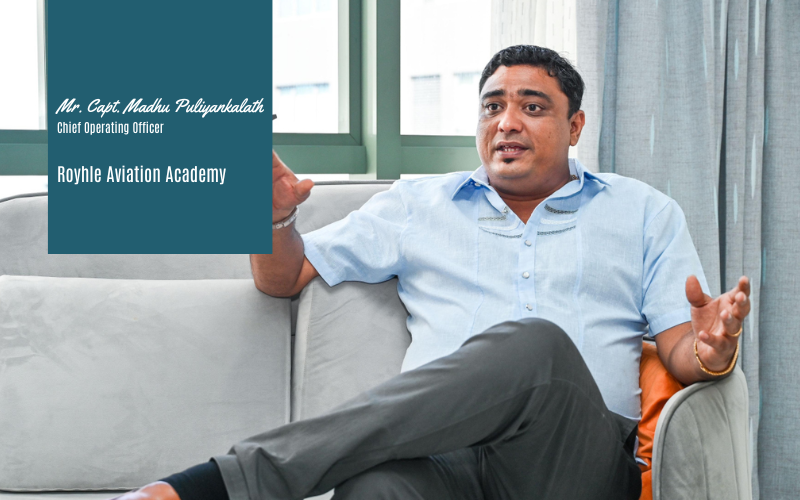
AviationBizz : What were the key factors that led to the establishment of Royhle Aviation Academy, and how has its vision evolved in response to the changing landscape of the global aviation industry?
Madhu Puliyankalath : Royhle Aviation Academy was established in 2013 in Dumaguete City, Philippines. Building upon its aviation foundation, Royhle Airway Charter Inc. was born in 2015, to cater VIP/Charter Flights, Medical Evacuations, Cloud Seeding Operations, Sky Diving Activities, Cargo Flights and Aerial Tours. Later, in 2020, International Aircraft Solution Maintenance (IASM) was established to ensure the highest standards of in-house maintenance. The key factors driving its establishment were the need for a premier, cost-effective flight training environment that could offer consistent weather and ample flying days. In 2013, Royhle had a very humble beginning with only 1 aircraft, parked under a jackfruit tree because there was no hangar at the time. Today, it has grown significantly, operating out of the largest hangar at Dumaguete Airport. The academy’s vision has evolved from its initial mission of providing high-quality pilot training to becoming the leading Flight Training Establishment in the Philippines. This evolution of the vision reflects the global aviation industry’s demand for professional, responsible, and safe pilots who exceed industry standards of excellence. The academy continues to adapt by expanding its international approvals and integrating advanced technologies to meet the needs of the global marketplace.
AB : In what ways does the academy continually refine and enhance its training methodologies to deliver industry-relevant and future-ready aviation education?
MP : Royhle Aviation Academy continually refines its training methodologies by incorporating global best practices and adopting evolving standards. A significant step in this direction was upgrading to modernization and digitization of processes relevant to aviation education. The academy ensures industry relevance through its team of highly experienced, competent, and safety-focused instructors. Furthermore, the academy maintains an exceptionally low instructor-to-student ratio of 1:5 and an aircraft-to-student ratio of 1:6, allowing for highly personalized and optimized learning approaches.
AB : Which core principles and long-term strategic goals continue to guide Royhle Aviation Academy in developing competent and responsible aviation professionals?
MP : The core principles guiding Royhle Aviation Academy are a safety-first approach, ethical standards, and a multicultural learning environment built on mutual respect. The academy has demonstrated this unwavering commitment to safety by achieving 16,000 flying hours without a single incident or accident in 2023.
Following this record-breaking year of accumulating the highest flying hours in its 10 years of operations, the academy successfully continued this flawless safety record throughout 2024 and 2025, proving that safety is not just a goal but a daily operational reality. Long-term strategic goals include becoming the premier flight training establishment in the region, expanding international regulatory approvals, and continuously producing pilots who are not only technically proficient but also responsible and safe in their future airline careers.
AB : How does Royhle Aviation Academy uphold excellence in aviation education while ensuring compliance with national and international regulatory standards?
MP : Excellence and compliance are upheld through rigorous adherence to the standards set by the Civil Aviation Authority of the Philippines (CAAP) and international bodies. The academy is fully ICAO compliant and holds approvals from multiple international authorities, including the Civil Aviation Authority of Vietnam (CAAV), the Civil Aviation Authority of Nepal (CAAN), and the Civil Aviation Authority of Maldives (MCAA). A testament to this excellence was achieved in February 2025, when Royhle became the first flight academy outside the Maldives to receive Approved Training Organization (ATO) status from the MCAA, aligning its operations with EASA standards.
AB : How are the academy’s academic programs reviewed and updated to remain aligned with evolving aviation regulations and the changing needs of the airline industry?
MP : The academy’s academic programs are continuously reviewed to ensure alignment with both national and international regulations, through periodic Internal Quality Audits, ensuring the curriculum meets the latest national standards. Additionally, the participation of its team in regulatory trainings, forums and assemblies ensures that it remains aligned with the standards.
AB : How does Royhle Aviation Academy balance theoretical knowledge with practical flight training to prepare students for professional aviation careers?
MP : The academy achieves an optimal balance between theory and practice through its structured curriculum. For example, the comprehensive Commercial Pilot License (CPL) program including ATPL Theory Course integrates theoretical training covering 750 total hours across 14 critical subjects from Aircraft Instruments to Advanced Flight Planning to CRM (Crew Resource Management) providing a solid intellectual foundation that directly supports the practical skills developed during the 220 flying hours in the full program.
AB : In what ways do the academy’s programs equip aspiring pilots with the technical expertise, operational skills, and confidence required for successful flight operations?
MP : Aspiring pilots are equipped with essential skills through a combination of modern flight simulators and actual aircraft training. The use of a full-motion Redbird FMX simulator and a Redbird SD 1000 fixed-base simulator allows students to master Instrument Flight Rules (IFR) procedures and basic flying techniques in a controlled environment before transitioning to the fleet of Cessna 152s, Cessna 172s, and Piper Senecas. Furthermore, cross-country training across more than 25 aerodromes, including challenging coastal and mountainous terrains, builds the operational confidence required for real-world flight operations.
AB : How do the academy’s state-of-the-art infrastructure and training facilities contribute to delivering a comprehensive aviation learning experience?
MP : The academy’s infrastructure is designed to support every aspect of pilot training. Royhle Aviation Academy operates from a dedicated three-storey training facility designed exclusively to support its academic and flight training operations. The third floor houses spacious classrooms, a library, and a student lounge that provide a conducive learning environment. The second floor serves as the academy’s reception area and administrative offices, while the ground floor is equipped with our flight simulation training facilities, allowing students to seamlessly integrate theoretical knowledge with practical application.The largest hangar at Dumaguete Airport houses its expanding fleet and engine overhauling facility, ensuring operational efficiency. Our hangar operations are supported by a digital central inventory system for all parts and tools, enabling real-time tracking, reducing turnaround times, and ensuring maximum aircraft parts and tools availability. State-of-the-art classrooms equipped with 86-inch smartboards facilitate interactive, IT-enabled learning. Beyond academics, the comprehensive facilities, including student lounges, briefing rooms, and in-house hostel accommodation, create a holistic environment where students can focus entirely on their training without logistical distractions.
AB : Could you provide an overview of the advanced flight simulators, aircraft, and technical resources that support the academy’s pilot training programs?
MP : Royhle Aviation Academy utilizes top-tier technical resources. The simulator suite includes a Redbird FMX full-motion simulator, which provides accurate motion feedback and immersive visuals, and a Redbird SD 1000 fixed-base simulator for IFR training. The aircraft fleet is modern and diverse, featuring Cessna 152 and 172 models for single-engine training, and Piper PA-34 Seneca aircraft for multi-engine and cross-country flights and night flying. To meet the growing demands of our student body, we have recently acquired 3 additional training aircrafts.
AB : How does Royhle Aviation Academy continue to strengthen its infrastructure and facilities to meet the evolving standards of aviation education?
MP : The academy continuously strengthens its facilities by investing in modern technology and expanding its capabilities. The upgrade to 86-inch smartboards in classrooms demonstrate a commitment to digital integration. Furthermore, the strategic choice of the Dumaguete Airport base, with its 6,000-foot runway capable of accommodating an Airbus A320, positions the academy to handle larger aircraft and more advanced training scenarios as industry standards evolve.
AB : How does the academy ensure students gain valuable exposure to real-world aviation operations and current industry practices?
MP : Students gain real-world exposure primarily through the expertise of their instructors. Additionally, the academy facilitates cross-country training across over 25 aerodromes, exposing students to diverse airspace, weather conditions, and airport operations.
AB : What opportunities are available for students to engage with aviation professionals, airline representatives, and industry experts throughout their training?
MP : Royhle actively fosters industry engagement through strategic partnerships. Students benefit from the academy’s relationships with industry experts whom we bring in for engagement and talks. Furthermore, collaborations with international training providers provide structured pathways and networking opportunities. The academy also hosts and sponsors industry events and seminars, such as aviation networking events in the Maldives and collaborative seminars in India and Vietnam.
AB : How do the academy’s industry collaborations and practical learning experiences prepare students for successful careers in commercial aviation?
MP : The academy’s collaborations, such as its partnership with training institutions, provide students with a clear and supported pathway to airline careers, including license conversion assistance. The practical learning experience, which includes extensive flying hours in diverse terrains and the use of advanced simulators, ensures that graduates are not just certified pilots but are fully prepared for the operational realities of commercial aviation, as evidenced by the numerous alumni flying for major carriers.
AB : In what ways are students equipped to meet the evolving challenges and responsibilities of today’s aviation industry?
MP : Students are equipped to meet modern challenges through a curriculum that integrates advanced safety standards and ethical training. The diverse, multicultural environment also prepares them to work effectively in the globalized and dynamic commercial aviation sector.
AB : How does Royhle Aviation Academy incorporate emerging technologies and innovative training methodologies into its aviation education programs?
MP : The academy incorporates innovation through its recently launched “Aviatize” platform, a comprehensive digital solution designed to modernize and optimize the entire training experience. Aviatize streamlines flight scheduling, progress tracking, student records, and communication between instructors and trainees, ensuring a more efficient and data-driven training process. Furthermore, the integration of modern digital tools in classrooms, such as the 86-inch smartboards, creates a dynamic learning environment.
AB : What role do advanced simulation systems and digital learning technologies play in enhancing the effectiveness of pilot training at the academy?
MP : Advanced simulation systems, particularly the full-motion Redbird FMX simulator, play a crucial role in enhancing training effectiveness by providing a realistic, safe environment for students to practice complex maneuvers and IFR procedures before flying actual aircraft. Digital learning technologies, including the recently launched Aviatize platform for streamlined training management and the e-learning platform for remote ground studies, facilitate deeper understanding and retention of theoretical knowledge. Interactive smartboards in classrooms further enhance engagement, allowing students to progress through the curriculum more efficiently and effectively.
AB : Which recent achievements, awards, or recognitions best reflect Royhle Aviation Academy’s commitment to excellence in aviation education?
MP : Recent achievements strongly reflect the academy’s commitment to excellence. In 2023, the academy celebrated a remarkable safety milestone, reaching 16,000 flying hours, the highest annual flying hours in 10 years, without a single incident or accident. Furthermore, in February 2025, Royhle Aviation Academy received Approved Training Organization (ATO) status from the Maldives Civil Aviation Authority (MCAA), becoming the first academy outside the Maldives to do so. The company’s charter operations also achieved the Basic Aviation Risk Standard (BARS) Gold accreditation, highlighting its high global safety standards.
AB : How do seminars, workshops, and industry-focused events contribute to enriching the academic and professional development of students?
MP : Industry events and seminars provide critical networking opportunities and exposure to real-world operational insights. For example, the aviation networking event organized in the Maldives and the collaborative seminars held with our training partners in India & Vietnam connect students and staff with broader industry professionals.
AB : What significant milestones have marked the academy’s journey and reinforced its contribution to the aviation training sector?
MP : Significant milestones include the academy’s founding in 2013, its expansion to include an in-house Approved Maintenance Organization (IASM).
The achievement of 16,000 incident & accident-free flying hours and MCAA ATO approval in 2025 are landmark events that reinforce its reputation. Additionally, the successful training and placement of over 200 Maldivian students, with over 50% now flying for major airlines, underscores its substantial contribution to the global aviation training sector. During COVID-19 pandemic, the academy was also recognized by the province of Negros Oriental for having donated significant essentials including repatriation flights and medical evacuations through its charter flight operations.
AB : What measures has the academy implemented to maintain consistent quality across its academic programs, training standards, and student support services?
MP : To maintain consistent quality, the academy employs advanced teaching techniques, including intensive review classes and panel interviews, ensuring students are thoroughly prepared for their regulatory exams. Quality assurance extends to aircraft safety through the academy’s own Approved Maintenance Organization (IASM), which conducts in-house engine overhauls. Furthermore, the academy provides robust student support services, including in-house hostel accommodation with meals, laundry service, and transportation, ensuring a comfortable and focused learning environment.
AB : How does the academy promote the overall personal and professional growth of students throughout their aviation education?
MP : The academy fosters student growth through a supportive and personalized learning environment with a 1:5 instructor-to-student ratio, ensuring individual attention and mentorship. Milestones such as the first solo flight are celebrated through traditions like the “Solo Bath Ceremony” and memorable graduation events. A dedicated student welfare service provides personalized support, especially for international students, from admission through settling into life in the Philippines, creating a strong “family culture.”
To promote overall well-being, the academy also organizes activities such as half-marathons and creative challenges. With students from countries including Vietnam, Bangladesh, Nepal, Myanmar, India, Oman, and the Maldives, it has built a diverse global community. Over the past 13 years, the academy has graduated more than 1,000 students, many of whom now fly for commercial airlines worldwide, reflecting the academy’s high training standards and successful alumni network.
About the Author