

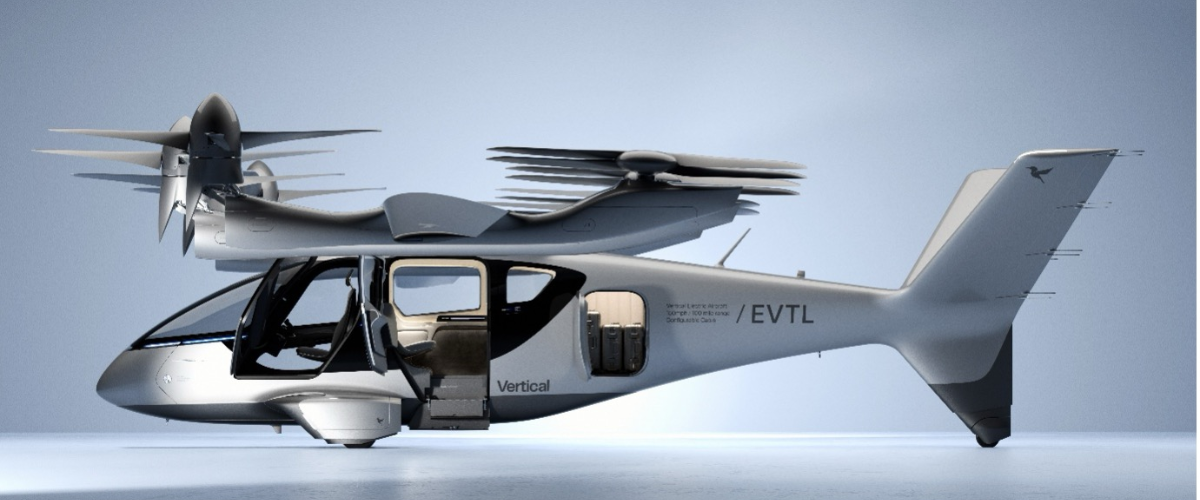
Planned new routes to cut multi-hour road journeys to minutes by air, targeting Canary Wharf–Heathrow in 12 Minutes Targeting Q1 2029 launch, collaboration unites aircraft, infrastructure and operating expertise – a blueprint for scalable urban air mobility globally Proposed network unveiled today alongside Vertical’s new aircraft, Valo, in Canary Wharf, London
London, UK; New York, USA; Houston, USA – December 10, 2025:
Vertical Aerospace (NYSE: EVTL), today announced plans with Skyports Infrastructure (Skyports) and Bristow Group (NYSE: VTOL), to launch the UK’s first electric air-taxi routes between Canary Wharf and major transport hubs. Proposed routes to and from Canary Wharf at launch would include Heathrow, Gatwick, Cambridge and Oxford.
By combining Vertical’s category-leading aircraft, Skyports’ London Heliport, Bicester Vertiport and future UK skyport network, and Bristow’s global operational expertise and UK Air Operator Certificates (AOCs), this partnership brings together the full ecosystem needed for real, scalable eVTOL services.
The first phase, planned from Q1 2029, will focus on the UK’s highest-value mobility corridors. The proposed routes, operated by Bristow, would dramatically cut journey times compared with traditional ground travel – for example, cutting a typical Canary Wharf-to-Heathrow transfer from 60–90 minutes on the ground to 12 minutes in the air.
Stuart Simpson, CEO, Vertical Aerospace, said:
“Electric flight will transform how cities move, and London is one of the best places in the world to prove it. With Skyports and Bristow, we have the aircraft, infrastructure and operational strength to lead this market. These plans show the commercial potential of services we aim to see operating following regulatory approval in 2028 and we look forward to bringing them to life with our partners.”
Duncan Walker, CEO, Skyports Infrastructure, said:
“We’re excited to build on our long-standing relationship with Vertical. Our Skyports London Heliport and Bicester skyport, combined with our global infrastructure expertise, make us ideally positioned to support early eVTOL services in the UK. With Bristow’s operational strength, we can accelerate plans for electric air taxi routes across the region, with the plan to create a UK-wide network.”
Chris Bradshaw, President & CEO, Bristow, said:
“Bristow’s role in Advanced Air Mobility is to leverage our 75+ years of leading vertical flight operations to bring real-world operational discipline to promising new aircraft and infrastructure concepts. Working with Vertical and Skyports on early eVTOL services in the UK allows us to apply our proven expertise in safe, reliable, and complex aviation operations to an important emerging market. This collaboration is a meaningful step as we progress a portfolio of advanced aircraft and explore how they can be deployed responsibly at scale.”
Building on proven partnerships
This collaboration builds on long-standing relationships:
- “OxCam AAM Corridor” demonstrator, which is bringing together the expertise of Skyports, Bristow Helicopters, NATS, Vertical Aerospace and Oxfordshire County Council, with the aim to accelerate the transition of Advanced Air Mobility (AAM) from trials to commercially viable, regional operations within the UK. The project will culminate in planned test flights by Vertical Aerospace’s prototype aircraft.
- Earlier this year, Bristow and Vertical also announced a Ready-to-Fly model providing turnkey access to aircraft, pilots, maintenance and insurance, alongside Bristow’s pre-order for up to 50 Valo aircraft, with options to purchase up to 50 more.
A major step for UK advanced air mobility (AAM)
Today’s announcement, made as Vertical unveils its new aircraft, Valo, at The Pelligon in Canary Wharf, demonstrates how eVTOL aircraft, vertiport infrastructure and experienced operators can deliver a clean, fast, high-performance transport network for the UK.
Valo will fly up to 100 miles at up to 150 mph, produce zero operating emissions, and through certification with the UK Civil Aviation Authority (CAA) and the European Aviation Safety Authority (EASA) is targeting to achieve the same safety standards as modern commercial airliners. Vertical targets producing 175 aircraft by 2030, ramping to 225+ annually by Q4 2030.
About the Author