
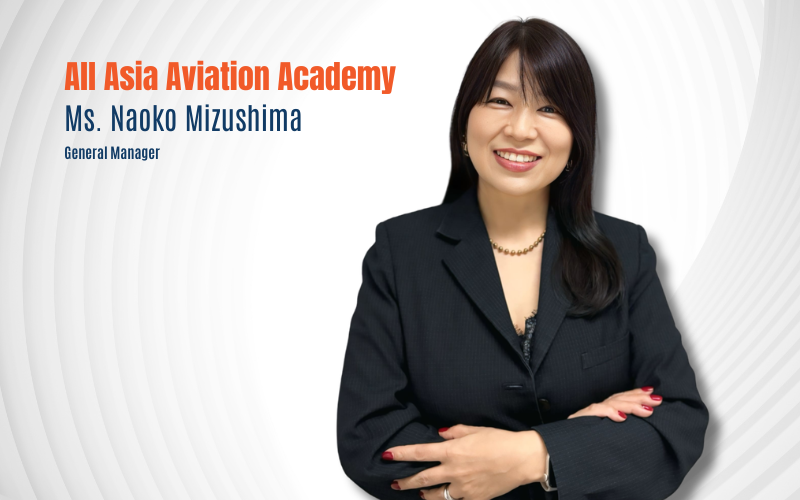
All Asia Aviation (AAA) Academy is a CAAP-approved flight school in the Philippines, offering pilot training since 2008 with programs including PPL, CPL, IR, MER, FI, and ATPL Ground. The academy follows Japanese management standards, offers the Airline Assessment Qualification (AAQ) course, and operates a CAAP-certified Aircraft Maintenance Organization (AMO) to ensure high-quality training and safety.
Aviation Bizz : What was the driving force behind establishing All Asia Aviation Academy, and how has its Japanese management culture supported its long-term growth?
Naoko Mizushima : AAA’s founding philosophy is to support the improvement of people’s lives across Asia. Our founder recognized that in many Asian countries, including the Philippines, which are made up of numerous islands, emergency transportation can be extremely challenging. With the vision of making aircraft as accessible and practical as taxis in the future, AAA was established. Currently, we follow a concept we call as Public Solution Support (PSS), to which we exist to address the problems of a country or community we are in, maintaining that we are driven by purpose rather than profits. Japanese management culture serves as the foundation for realizing this philosophy. Through disciplined training and a consistent commitment to honest, quality-focused operations, AAA has provided training to students from more than 50 countries, and our graduates are now active in airlines around the world.
AB : Looking back on your journey, what have been the most defining milestones that have shaped All Asia Aviation Academy into a globally recognized flight training institution?
NM : Rather than a single turning point, I believe AAA’s growth has been built on the trust we have earned over many years. Since its founding, AAA has consistently upheld Japanese standards of management, emphasizing clean, honest, and transparent operations. Maintaining these values in the Philippines has not always been easy, but our unwavering commitment has earned the trust of our students, airline partners, and stakeholders. In addition, the success of our graduates, who are now flying for airlines around the world, has further strengthened AAA’s
reputation. Their achievements have helped establish AAA as an international pilot training academy, attracting students from countries across the globe.
AB : As aviation education continues to evolve, how do you ensure the academy remains aligned with global industry standards while preserving its founding values?
NM : Since our founding, we have continued to uphold our philosophy of “supporting the improvement of people’s lives across Asia,” while continuously evolving our education to meet the needs of the times. In line with the standards required by the global aviation industry, we have introduced modern training equipment – from our flight simulator to our training aircrafts, followed by our training programs with the goal of being able to provide practical training that meet the expectations of airlines in various countries. At the same time, we continue to place great importance on Japanese-style discipline, safety awareness, and a sincere approach to education. We believe AAA’s strength lies in preserving our founding philosophy while developing pilots who can succeed on the global stage.
AB : What distinguishes All Asia Aviation Academy from other aviation training institutions, and how do you consistently deliver world-class pilot education to students from diverse nationalities?
NM : AAA’s greatest strength is its EFFICIENCY, both in management and operations which we perfected and continue to develop for almost 20 years. Our efficient training schedule provides an environment where students can progress through their flight training without unnecessary delays., as well as our internal management system and policies are all supported and based on by Japanese-style management which is target and result oriented. We have also welcomed students from more than 50 countries and have provided consistent training to students from diverse backgrounds. In addition, our orientation of utilizing Japanese-quality management emphasizes discipline and safety awareness, we believe the fact that our graduates are now active in airlines around the world demonstrates that AAA’s education meets global standards.
AB : How does the academy balance academic excellence, practical flight training, and professional discipline to prepare students for successful aviation careers?
NM : At AAA, students first build a solid foundation of knowledge through ground school, and then apply that knowledge through simulator and actual flight training. Through disciplined, Japanese-style education, we also cultivate strong safety awareness and a professional mindset. Our goal is not simply to train students to obtain a license, but to develop pilots who can succeed at airlines around the world.
AB : With students enrolling from across the globe, how do you create an inclusive learning environment that supports different cultures, backgrounds, and career aspirations?
NM : As part of a multi-national company based in Japan, upon entering the Philippines and forming AAA Academy – our orientation already was how we would be able to accommodate students from around the world and to foster an environment that promotes diversity. To do this, AAA brings together students, instructors, and staff from countries around the world.
Our staff and personnel training also comes from our belief that understanding and respecting different cultures, values, and religions is the first step in creating an environment where students can learn with confidence. For this reason, we respond flexibly to individual needs, including meals and living arrangements that take religious and cultural backgrounds into consideration. One of AAA’s key strengths is providing an environment where each student, regardless of nationality, can feel secure and focus fully on their training.
AB : How are your pilot training programs designed to meet the changing requirements of commercial airlines and international aviation authorities?
NM : AAA’s core training program is designed to enable students to obtain a Philippine pilot license. At the same time, we also provide additional training and support tailored to the requirements of each country’s aviation authority, enabling graduates to convert their Philippine license to their home country’s license after graduation. In addition, we incorporate the practical skills and safety awareness required by airlines into our training, with the goal of developing pilots who can adapt to the needs of different countries and airlines around the world.
AB : What approach does the academy follow when updating its curriculum to ensure students develop both strong technical knowledge and real-world operational skills?
NM : Our curriculum is reviewed regularly to reflect the knowledge and skills required by the aviation industry and airlines around the world. In addition to ground school, we combine simulator training with actual flight training to ensure that students develop not only the skills needed to obtain their licenses, but also the decision-making ability and safety awareness required in real-world flight operations. We also ensure that our curriculum and all training implementations are up to standard and compliance by our local authority.
AB : How do instructors integrate advanced learning methodologies and practical flight experiences to help students confidently transition into professional aviation careers?
NM : At AAA, our instructors tailor their guidance to each student’s level of proficiency and provide practical flight training with safety as the highest priority. In addition to teaching flying skills, they place strong emphasis on developing the judgment, sense of responsibility, and discipline required of professional pilots, with the goal of preparing graduates to become airline-ready pilots who can contribute from day one.
AB : Your campus at Iba Airport offers a unique training environment. How does this infrastructure contribute to improving students’ flight training experience and operational confidence?
NM : One of the greatest advantages of our campus being based in Iba Airport is that currently – we are the ONLY FLIGHT SCHOOL that is based and has standing structures in the airport. This means there is minimal air traffic congestion and allows students to conduct flight training more efficiently compared to anywhere else. In particular, they can perform a sufficient number of fundamental exercises, such as touch-and-go training, enabling them to steadily develop their flying skills. In addition, the airport’s coastal location exposes students to natural conditions such as sea winds, helping them develop practical flying techniques and sound decision-making skills. This training environment plays an important role in building both their technical competence and confidence as pilots. The location also is conveniently located to ideal cross-country sites that our students also fly to as part of their training, making our curriculum better in terms of providing students with proper flight training experience.
AB : Could you share how your in-house aircraft maintenance, training facilities, and examination systems enhance safety, efficiency, and learning outcomes?
NM : A fact is – not all Training Organizations in the Philippines operate their own, private Maintenance Organization. At AAA, we have invested to operate our own Aircraft Maintenance Organization (AMO), enabling us to keep our aircraft in a consistently safe condition while carrying out maintenance and inspections promptly and exclusively. As a result, aircraft availability is maximized, allowing students to progress through their flight training efficiently and according to schedule. The fact that we also maintain our own aircrafts gives us and our instructors and students – confidence that all aircraft operate safely and above-standard. In addition, by integrating our training facilities and examination systems, we maintain both safety and educational quality while providing students with a consistent and well-structured learning environment.
AB : What future infrastructure developments or facility enhancements are being planned to support the next generation of aviation professionals?
NM : At AAA, we continue to invest in our facilities and equipment to develop the next generation of aviation professionals. Two years ago, we added six training aircraft to our fleet, creating an environment where more students can receive flight training efficiently. Looking ahead, we plan to establish our own Engine Overhaul facility. This will minimize aircraft downtime, enabling us to provide a more efficient and stable training environment while further enhancing the quality of our education.
AB : How does All Asia Aviation Academy collaborate with airlines, aviation organizations, and industry partners to provide students with meaningful career opportunities?
NM : At AAA, we place great importance on collaboration with airlines and industry partners. We believe that our consistency in producing competent, professional and knowledgeable pilots throughout the years have given us the trust and confidence of airlines and other organizations that allow us to have existing collaborations and even programs that result to airline assessment. In addition, through regular exchanges of information, we incorporate the qualities and recruitment needs sought by the aviation industry into our educational programs. We also provide opportunities for students to interact with airlines and gain career-related insights, helping them become more familiar with the aviation industry and supporting a smooth transition toward a professional pilot career.
AB : What role do internships, airline assessment programs, and industry interactions play in preparing graduates for the highly competitive aviation sector?
NM : Through our Airline Assessment Program, we provide practical training that reflects the airline recruitment process, including written examinations and interview preparation. As a result, students gain not only the qualifications required to obtain their pilot licenses, but also the knowledge, communication skills, and professional attitude expected by airlines. We believe that this plays a significant role in helping graduates make a smooth transition into the airline recruitment process after completing their training.
AB : What support systems are available to help international students successfully adapt to academic life, training requirements, and career planning?
NM : At AAA, our dedicated staff provide comprehensive support for international students, including visa applications and renewals, as well as various procedures with the aviation authorities, allowing students to focus on their studies and flight training. By minimizing the administrative burden outside of training, we provide an environment where students can study with confidence and fully concentrate on preparing for their future careers.
AB : How do alumni success stories influence the academy’s mentoring approach and inspire current students to achieve excellence in aviation?
NM : The success of our graduates, who are now flying for airlines around the world, serves as a great source of inspiration for our current students and motivates them to give their best in their daily training. Seeing these achievements encourages students to aspire to follow in their predecessors’ footsteps and build careers on the global stage. It inspires them to keep striving toward their goals and gives them the confidence to believe in their own potential.
AB : Aviation technology is advancing rapidly. How is All Asia Aviation Academy incorporating next-generation simulators, digital learning tools, and modern training technologies into its programs?
NM : Firstly, we utilize a simulator that is highly regarded and widely recognized within the aviation industry and we continue to update and upgrade the sim based on the latest available and as per the direct manufacturer’s recommendation. This combines our simulator training with actual flight training to deliver efficient and effective education. We also continuously review and improve our training manuals and educational programs based on changes in the aviation industry and feedback from our instructors. By actively incorporating the latest technologies, we continually strive to enhance both safety and the quality of our training.
AB : AAA Academy has earned recognition for its training excellence and international presence. Which recent achievements or milestones are you most proud of, and why?
NM : What I am most proud of, and what I believe is the greatest achievement we could ever achieve is that AAA graduates are able to successfully work and fly for airlines around the world. In addition, in recent years, we have also been entrusted by international airlines to provide recurrent simulator training for their active pilots. We believe this is a testament to the quality of our education and training, demonstrating that it is trusted not only for student pilot training but also for the ongoing professional development of active airline pilots. We have also seen a steady increase in the number of students from overseas, including India, Indonesia, and Nepal, reflecting AAA’s continued growth as an international aviation training academy. Moving forward, we will continue to prioritize safety while developing pilots who can succeed globally and contribute to the advancement of the aviation industry.
AB : Looking ahead, what are your strategic priorities for expanding the academy’s global footprint and contributing to the future of aviation education?
NM : Looking ahead, we aim to further expand into international markets and welcome students from an even wider range of countries, thereby contributing to the global aviation industry. As the worldwide pilot shortage continues, we believe that developing highly qualified pilots is one of AAA’s most important missions. Guided by our founding philosophy of supporting the improvement of people’s lives across Asia, we will continue to develop aviation professionals through quality education and contribute to the growth of the aviation industry across Asia and around the world.
About the Author