

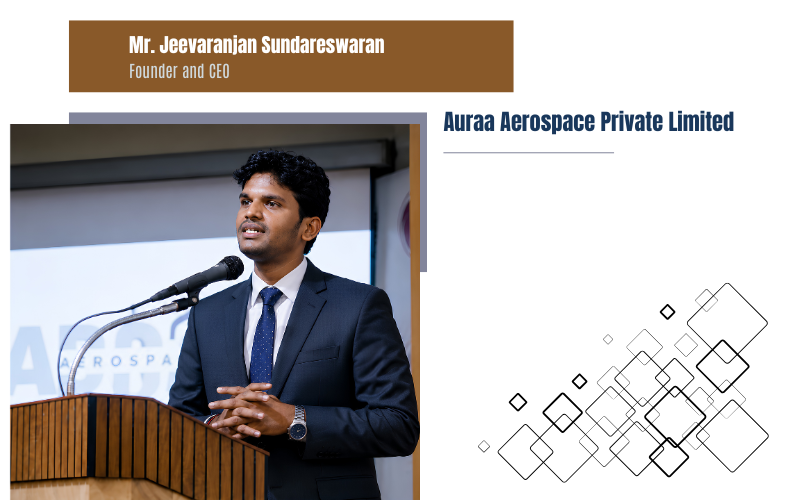
Auraa Aerospace Private Limited
Auraa Aerospace Private Limited is India’s leading indigenous drone and aerospace technology company, headquartered in Madurai, Tamil Nadu, India. With a vision rooted in self-reliance and innovation, we specialize in the design, development, and deployment of advanced surveillance drones, defense-ready UAVs, and custom embedded systems that cater to national security, industrial operations, and civil applications.
AviationBizz : What inspired the team to enter the aerospace sector and address India’s growing UAV requirements?
Jeevaranjan sundareswaran : Auraa Aerospace was founded with the vision of contributing to India’s rapidly evolving aerospace and drone ecosystem. The founders recognized the growing demand for indigenous UAV solutions across sectors such as defense, surveillance, infrastructure inspection, agriculture, and logistics. At a time when many organizations depended heavily on imported technologies, we saw an opportunity to develop reliable, innovative, and cost-effective drone systems tailored to Indian operational requirements. Our mission has always been to combine engineering excellence with practical applications that solve real-world challenges while supporting India’s vision of technological self-reliance and innovation-driven growth.
AB : What were the biggest challenges faced during the initial stages of establishing the company and developing its first drone platforms?
JS : Like many technology startups, our initial journey involved overcoming challenges related to research and development, funding, testing, and market acceptance. Developing reliable drone systems requires significant investment in design, prototyping, software integration, and regulatory compliance. Another challenge was building customer confidence in locally developed UAV technologies. Through continuous testing, collaboration with industry experts, and a strong commitment to quality and innovation, we successfully transformed these challenges into opportunities for growth and technological advancement.
AB : What key milestones have been most significant in shaping the company’s journey so far?
JS : Several milestones have played a crucial role in our growth. Successfully developing and deploying our initial drone platforms validated our technological capabilities and market potential. Expanding our product portfolio to serve multiple sectors strengthened our market presence. Collaborations with educational institutions, industry partners, and innovation ecosystems helped accelerate product development and talent acquisition. Participation in industry events, training initiatives, and technology showcases further enhanced our visibility and credibility. Each milestone has contributed to our vision of becoming a leading player in India’s aerospace and UAV industry.
AB : How does the company ensure that its products meet the diverse operational requirements of different sectors?
JS : Our approach begins with understanding the unique challenges faced by customers across different industries. We design our drone platforms with flexibility and adaptability in mind, allowing them to be customized for various applications such as surveillance, mapping, inspection, logistics, and training. Continuous customer feedback, field testing, and performance evaluations help us refine our solutions.
By combining advanced hardware, intelligent software systems, and modular configurations, we ensure that our products deliver reliability, efficiency, and operational effectiveness in diverse environments.
AB : How does the modular and swappable payload design philosophy improve mission flexibility and operational efficiency?
JS : A modular design significantly enhances the versatility of drone systems. Instead of requiring separate drones for different missions, users can quickly interchange payloads such as cameras, sensors, communication equipment, or specialized tools depending on operational needs. This reduces costs, simplifies maintenance, and improves resource utilization. It also enables organizations to respond rapidly to changing mission requirements while maximizing the value of their investments. Ultimately, modularity allows customers to achieve greater operational flexibility and efficiency with a single drone platform.
AB : What ongoing R&D initiatives are focused on improving flight endurance, payload capacity, autonomous navigation, and overall drone performance?
JS : Research and development remain central to our growth strategy. Our teams continuously work on improving energy efficiency, lightweight structural design, advanced battery management systems, and aerodynamic performance to increase flight endurance. We are also exploring intelligent flight-control systems, AI-powered navigation, obstacle avoidance technologies, and autonomous mission planning capabilities. Additional efforts focus on enhancing payload integration, communication systems, and real-time data processing. These innovations are aimed at creating safer, smarter, and more capable drone solutions for future applications.
AB : How does Auraa Aerospace identify emerging market opportunities and customer needs?
JS : We closely monitor industry trends, technological advancements, regulatory developments, and customer feedback across multiple sectors. Direct engagement with clients, participation in industry forums, and collaboration with research institutions provide valuable insights into evolving market demands. Our team evaluates emerging applications where drones can create operational efficiencies or solve critical challenges.
AB : What role does innovation play in helping the company compete against established domestic and international drone manufacturers?
JS : Innovation is a key differentiator for Auraa Aerospace. Rather than simply replicating
existing technologies, we focus on developing solutions that address specific customer challenges and operational environments. Continuous investment in research, product enhancement, and emerging technologies allows us to improve performance, reliability, and usability. Innovation also helps us remain agile in a rapidly changing industry while delivering competitive advantages through customization, affordability, and advanced technological capabilities.
AB : How is Auraa Aerospace leveraging AI-enabled tracking, obstacle avoidance, and smart analytics to create next-generation UAV solutions?
JS : Artificial intelligence is transforming the capabilities of modern UAV systems. We are integrating AI-driven technologies to enhance autonomous decision-making, object detection, tracking accuracy, and mission efficiency. Smart obstacle avoidance systems improve operational safety, while advanced analytics convert collected data into actionable insights for users. These capabilities enable drones to perform increasingly complex missions with greater precision, reliability, and reduced operator workload.
AB : How does the “One Drone, Endless Possibilities” strategy strengthen market competitiveness?
JS : This strategy reflects our commitment to maximizing customer value through versatile drone platforms. By designing systems capable of supporting multiple payloads and mission profiles, customers can perform a wide range of tasks without investing in separate specialized drones. This approach reduces ownership costs, increases operational flexibility, and improves return on investment. It also allows us to serve diverse industries while maintaining a scalable and efficient product ecosystem.
AB : What lessons have been learned from deploying drone solutions across multiple sectors?
JS : One of the most important lessons is that every industry has unique operational requirements and challenges. Success depends not only on advanced technology but also on understanding user needs and delivering practical solutions. We have learned the importance of adaptability, continuous improvement, user training, and strong customer support. Real-world deployments have also highlighted the value of reliability, data accuracy, and ease of operation in ensuring successful outcomes.
AB : How important are collaborations with academic institutions, industry partners, and government initiatives?
JS : Collaborations play a critical role in accelerating innovation and growth. Academic institutions contribute research expertise and talent development, while industry partnerships provide valuable market insights and application opportunities. Government initiatives support innovation, entrepreneurship, and technology adoption through policy frameworks and development programs. Together, these collaborations help strengthen our technological capabilities, accelerate product development, and contribute to the broader aerospace ecosystem.
AB : Which international UAV trends will have the greatest impact on the drone industry over the next decade?
JS : Several global trends are expected to reshape the UAV industry, including autonomous operations, artificial intelligence, drone swarming technologies, advanced sensors, and beyond-visual-line-of-sight (BVLOS) capabilities. Improvements in battery technology and communication networks will further enhance operational efficiency.
These advancements will expand drone applications across defense, logistics, infrastructure management, environmental monitoring, and urban mobility, creating significant opportunities worldwide.
AB : How can Indian drone manufacturers leverage global advancements while maintaining technological independence?
JS : Indian manufacturers can adopt global best practices while investing in indigenous research, local manufacturing, and domestic supply chains. Building strong partnerships with research institutions and technology providers can accelerate innovation without creating long-term dependency. A balanced approach that combines international learning with local innovation will help strengthen India’s competitiveness and support its vision of becoming a global drone manufacturing hub.
AB : What breakthrough technologies are most promising for future aerospace innovation?
JS : Technologies such as AI-powered autonomy, drone swarms, advanced LiDAR systems, machine vision, edge computing, and next-generation energy storage solutions have tremendous potential. These innovations will improve mission efficiency, autonomy, and decision-making capabilities. Additionally, advancements in materials science, quantum communication, and intelligent sensor fusion may unlock entirely new possibilities for aerospace applications in the coming years.
AB : Which application areas offer the highest growth potential in the global drone market?
JS : Defense and security remain major growth drivers, but significant opportunities also exist in logistics, agriculture, infrastructure inspection, environmental monitoring, mining, and smart city development. As regulations evolve and technologies mature,
commercial drone adoption is expected to accelerate across numerous industries. Organizations increasingly recognize drones as valuable tools for improving productivity, safety, and operational efficiency.
AB : How do you envision India’s role in becoming a global hub for drone manufacturing and innovation?
JS : India has the potential to become a global leader in drone technology due to its strong engineering talent, growing startup ecosystem, supportive government policies, and expanding domestic market. Continued investment in research, manufacturing infrastructure, and skill development will be critical. By focusing on innovation, quality, and export-oriented growth, India can establish itself as a major contributor to the global aerospace industry.
AB : What strategic initiatives is Auraa Aerospace planning to pursue for future growth?
JS : Our growth strategy focuses on expanding product capabilities, strengthening research and development, entering new market segments, and enhancing customer engagement. We also aim to explore emerging technologies, develop advanced autonomous systems, and build strategic partnerships that support innovation and market expansion. Continuous investment in talent, technology, and operational excellence will remain central to our long-term vision.
AB : How does Auraa Aerospace contribute to skill development and STEM education?
JS : We actively engage in training programs, workshops, and educational initiatives designed to inspire the next generation of aerospace professionals. By providing hands-on exposure to drone technologies, we help students and young engineers develop practical skills and industry knowledge. These efforts contribute to workforce development while fostering innovation and entrepreneurship within the aerospace sector.
AB : How can drone technology support disaster management, environmental monitoring, and public safety?
JS : Drones offer rapid deployment, real-time data collection, and enhanced situational awareness during emergencies. They can assist in search and rescue operations, disaster assessment, infrastructure inspections, environmental monitoring, and public safety initiatives. By providing accurate and timely information, drones help authorities make informed decisions and improve response effectiveness while reducing risks to human personnel.
AB : How does the company balance technological advancement with responsible innovation and sustainability?
JS : Responsible innovation is an integral part of our development philosophy. We prioritize safety, regulatory compliance, environmental responsibility, and ethical technology deployment. Sustainable manufacturing practices, efficient resource utilization, and continuous quality improvement help minimize environmental impact. Our goal is to ensure that technological progress creates long-term value for customers, society, and future generations.
AB : How have workshops, training programs, and Centre of Excellence initiatives strengthened the company’s industry presence?
JS : These initiatives provide valuable platforms for knowledge sharing, skill development, and stakeholder engagement. They help build awareness about emerging drone technologies while creating opportunities to interact with students, professionals, industry leaders, and policymakers. Such programs strengthen our industry relationships and position Auraa Aerospace as a contributor to innovation and talent development within the aerospace ecosystem.
AB : Could you share recent achievements or project milestones that have been particularly meaningful?
JS : Among our most meaningful achievements are the successful deployment of drone solutions across multiple application areas, expansion of our technology portfolio, and growing recognition within the aerospace community. These accomplishments reflect the dedication of our team, the trust of our customers, and our commitment to delivering innovative solutions that address real-world challenges.
AB : Are there any upcoming innovations, collaborations, or technology showcases stakeholders should watch for?
JS : We are continuously working on new product enhancements, advanced autonomous capabilities, and collaborative initiatives that will expand the possibilities of drone technology. Future developments will focus on improving performance, intelligence, and operational flexibility. We also look forward to participating in industry exhibitions, innovation forums, and collaborative projects that showcase the next generation of UAV solutions.
AB : How do developments such as logistics delivery drones and UAV Centres of Excellence align with your long-term vision?
JS : These developments are closely aligned with our vision of building a robust and future-ready aerospace ecosystem. Logistics drones represent a major growth opportunity with the potential to transform transportation and supply chain operations. Similarly, Centres of Excellence help cultivate skilled talent, promote research, and accelerate innovation.
About the Author