

In 1949, 11 airlines walked into a room. No punchline. just the start of global travel talking to itself. They had one shared headache; nothing connects. So they built something that did. At the time, it was the largest node network of its kind. It even inspired the early internet. We’d say we don’t want to brag about that, but hey, here we are. In a nutshell, we’re transforming travel, making it safer, more sustainable, and that much easier to love. Travel is meant to connect us. We’re the quiet part that makes sure it does.
Aviation Bizz : How has SITA’s original vision of collaboration helped the company remain a leader in aviation technology?
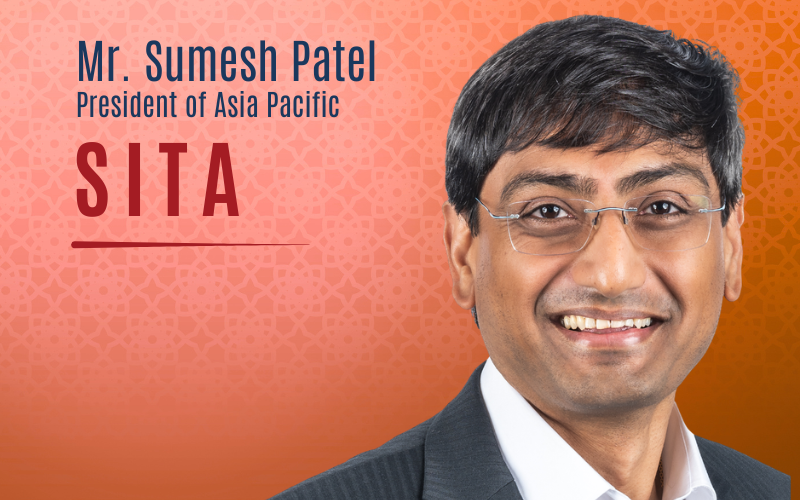
Sumesh Patel : SITA was born out of a simple but powerful idea: airlines compete in the air but cooperate on the ground. Eleven airlines came together in 1949 to build shared communications networks that none of them could have built alone. That founding instinct — industry-owned, industry-focused, built on trust — remains at the core of what SITA is today.
The milestones speak for themselves. The world’s first global airline reservations network. The first common-use airport systems. The baggage tracking infrastructure that became, and remains, the global standard for baggage recovery. And a presence at the centre of every major wave of aviation digitisation since.
What has defined SITA across every era is an unwavering drive to build what the industry needs next. From the first shared reservations network to today’s AI-driven operational systems, SITA has evolved alongside every major shift in aviation — not as an observer, but as the infrastructure that makes those shifts possible. The challenge today is more complex than connectivity: it is about turning vast flows of operational data across airlines, airports, ground handlers, and border agencies into faster, smarter decisions in real time. That is the same founding instinct at work — industry-owned, industry-focused — now expressed at a scale and speed the original eleven airlines could never have imagined.
AB : SITA operates across passenger processing, baggage management, border intelligence, and aircraft communications. In an increasingly competitive aviation IT landscape, where does SITA’s most distinct advantage lie today?
SP : SITA’s most distinct advantage is straightforward: we are the only technology and AI services company dedicated end-to-end to the world’s airports and airlines. From airport management to passenger processing to baggage recovery, every solution has been built for aviation’s specific demands — and designed to deliver regardless of an airport’s existing technology environment.
WorldTracer® illustrates this well. As the global standard for baggage tracking and recovery, it delivers world-class performance not because it is the most complex system in the market, but because it was purpose-built for aviation’s operational realities — and trusted by the industry to work seamlessly within them. That same principle holds across every solution in our portfolio.
But the compounding advantage comes when these solutions work together. Underpinned by a framework of secure, consistent, and transparent data sharing — and increasingly powered by AI — the combined effect grows exponentially. We are not just helping airports run more efficiently. We are helping them personalise and humanise the passenger experience at scale. For an industry that exists to bring people together, that connection is now the strategic differentiator.
AB : Biometric identification, digital identity systems, and touchless travel are moving from pilot projects to mainstream deployment. How are these technologies fundamentally changing what it feels like to move through an airport — and how far along is the industry in delivering on that promise?
SP : The technology to transform the passenger experience already exists. What is still being worked out is the coordination to deploy it consistently across the full journey.
Biometrics are no longer experimental. 54% of airports globally have live biometric border control today, rising to 83% by 2028. Passengers are not just tolerating this shift — they are driving it. SITA’s Passenger IT Insights report shows 62% would actively choose a biometric checkpoint over a traditional border counter. The share of passengers who have never used biometrics dropped from 41% to 31% in a single year.
But the real opportunity extends far beyond any single touchpoint. Biometrics running continuously through the full passenger journey — check-in, bag drop, security, boarding, immigration — without repeated identity checks at each step. 79% of passengers are already comfortable storing their passport on their phone. 78% are happy to share biometric data ahead of travel. Passengers have cleared the bar. What the industry needs now is the alignment to meet them there — getting every system, across every operator, to recognise the same passenger consistently at whichever point in the journey.
Our whole-journey biometric identity solutions are the practical expression of this vision. They are already live at major airports, delivering faster processing, fewer bottlenecks, and a journey that increasingly feels the way passengers expect it to.
AB : SITA has invested significantly in AI-driven operational systems and Digital Twin technologies. How are these tools helping airlines and airports improve efficiency, reduce fuel consumption, and make measurable progress on sustainability?
SP : Aviation operations are undergoing a fundamental shift — from reactive to predictive, and increasingly toward real-time orchestration. Digital twins are at the centre of that change, giving teams the ability to simulate the impact of decisions before making them, identify bottlenecks before they materialise, and test new processes without disrupting real passengers. The result is better planning, faster disruption response, and measurably more efficient operations.
AI is where the pace of change is most visible but its transformative potential is only fully realised when it operates across an ecosystem built on shared data. 63% of airlines now use AI in operations control to manage disruption, crew availability, and aircraft assignment in real time. At airports, AI anticipates queue build-up, coordinates turnaround activities, and flags potential delays before they cascade. Without consistent, transparent data flowing across every part of the operation, these capabilities work in isolation — but when that foundation is in place, the impact across the entire ecosystem grows significantly.
On sustainability, the impact is measurable. Advanced flight optimisation solutions are delivering measurable fuel and emissions reductions by helping airlines operate more efficiently. For example, Air India Group has projected annual emissions savings of approximately 35,000 tonnes through the deployment of data-driven flight optimisation technologies. That is not a future ambition. It is happening today.
AB : The pace of change in aviation technology — AI, automation, cloud infrastructure — shows no signs of slowing. How is SITA shaping its innovation strategy to stay ahead, and how important is open collaboration with airlines, airports, startups, and research institutions in that effort?
SP : SITA develops solutions with customers, not for them. The problems worth solving are the ones airlines and airports are actually facing. The best way to understand those problems is to work alongside the people dealing with them every day.
Our Customer Experience Centre in Singapore is a direct product of that approach. Built in response to sustained demand from airline and airport partners, it gives customers a real environment to see, test, and evaluate next-generation technologies before committing to deployment. The demonstrations there reflect capabilities that came directly out of collaborative conversations with the industry.
Open collaboration with startups and research institutions accelerates what internal R&D alone cannot. SITA continues to explore next-generation capabilities such as AI orchestration, autonomous airport operations, and urban air mobility integration to help the industry prepare for future demands. Several of these capabilities are already being trialled at major airports worldwide.
The discipline we maintain is relevance. Innovation pursued for its own sake has limited value in an industry as operationally demanding as aviation. Every capability we develop has to solve a real problem, at real scale.
AB : Across biometrics, blockchain, predictive analytics, and generative AI, where do you see the single biggest long-term transformation opportunity for global air transport — and why?
SP : Of all the technologies shaping aviation’s future, AI orchestration has the greatest long-term transformative potential. Not AI as a prediction tool, but AI as the active coordinator of complex, multi-system decisions across the entire operational ecosystem.
We are moving toward an environment where AI does not simply flag a problem for a human to act on. It evaluates the full range of recovery options simultaneously and executes decisions in real time. When something goes wrong at an airport, AI can open a new security lane automatically. When a bag risks a missed connection, AI triggers the rerouting before the passenger knows there was ever an issue.
The enabling condition for all of this is digital identity. Once a passenger is consistently recognised across every system throughout their journey, every other capability becomes more powerful. Disruption management improves. Baggage tracking improves. The intermodal journey becomes possible because a single credential is recognised across air, rail, and road.
But none of this is achievable without the right data foundation. AI orchestration depends on accessing the correct data at the right time, in a consistent format — and that data must be secure and connected across every part of the ecosystem. Ensuring that foundation is in place is not a technical footnote. It is what unlocks everything else.
The technology exists. What determines how quickly it becomes reality is the industry’s willingness to share data and align systems across organisational boundaries. The companies and airports that get this right first will set the standard for everyone else.
AB : With decades of experience working alongside airlines and airports globally, what are the most persistent operational challenges the industry faces today, and where is technology making the most meaningful difference?
SP : The most persistent challenge has not fundamentally changed: fragmented data. Systems built independently, by different vendors, at different times, using different standards, still do not communicate as cleanly as the industry needs. When operational data is fragmented, decisions slow down, disruptions cascade, and the passenger pays the price.
The second challenge is scale. IATA projects two billion additional passengers by 2030. Airports cannot keep building their way out of capacity pressure. The answer has to be operational intelligence — getting dramatically more performance out of existing infrastructure through better data, better AI, and better coordination.
Cybersecurity is the third challenge, and it is growing in complexity. As aviation systems become more interconnected, the risk profile changes. A cyber incident no longer affects a single platform. It affects the integrity of shared operational data that every part of the ecosystem depends on. 71% of airports now list cybersecurity as their top IT focus area.
The root cause underlying all three is the same: the industry optimises in silos. Airlines, airports, ground handlers, and border agencies each manage their own piece of the journey independently, often at the cost of the end-to-end experience. The organisations that crack coordination will be the ones that perform best under pressure.
AB : Asia Pacific is the world’s fastest-growing aviation market, and India sits at the centre of that story — with one of the most ambitious airport expansion programmes anywhere on the planet. What does digital transformation look like in this context, and what opportunities does it create for aviation technology companies like SITA?
SP : Asia Pacific is not just the world’s fastest-growing aviation market. It is where the future of aviation is being built in real time, at a scale and pace unmatched anywhere else. APAC accounts for more than half of the world’s new passenger traffic. APAC passengers average 4.4 flights per year — the highest of any region globally.
India sits at the centre of that story. New terminals, new airports, new routes, and a rapidly expanding passenger base. What makes India particularly compelling from a technology perspective is that much of this infrastructure is being built from the ground up — creating the opportunity to deploy best-in-class digital systems without legacy constraints. SITA’s footprint reflects that opportunity: our passenger processing solutions — spanning common-use check-in, self-service kiosks, and baggage reconciliation — are operational across 61 airports in India, our Airport Management System is deployed at 15 Indian airports, and our biometric digital identity solutions power DigiYatra across 28 airports, enabling passengers to move through terminals using facial recognition alone.
The appetite for digital transformation across the region is matched by real adoption. Biometric and digital identity uptake in APAC is outpacing Europe and the Americas. APAC airports are investing heavily in AI-driven passenger processing and operational management. And the region’s passengers — younger, mobile-first, and accustomed to seamless digital experiences — are among the most ready in the world to embrace frictionless travel.
For SITA, APAC is not simply a growth market. It is a proving ground. The solutions being deployed here are setting a standard the rest of the world is watching. In India specifically, advanced flight optimisation capabilities are already helping Air India Group deliver measurable fuel and emissions reductions across its fleet.
AB : SITA achieved CarbonNeutral® certification ahead of many industry peers, and has received global recognition for its work in biometrics and airport digital transformation. As the industry looks ahead, what sustainability commitments and innovations are you most proud of — and what can the industry expect from SITA in the near future?
SP : Sustainability in aviation cannot be an afterthought. It has to be built into operations — into every flight, every turnaround, every decision made in an operations centre.
SITA achieved CarbonNeutral® certification through internal operational changes and a commitment to helping customers reduce their environmental footprint through technology. One example of that commitment is the use of advanced flight optimisation capabilities to help airlines reduce fuel burn and emissions. The Air India Group deployment alone is projected to cut 35,000 tonnes of emissions annually. Multiply that across the airlines using these tools globally, and the aggregate impact is significant.
The recognition SITA has received in biometrics, airport digital transformation, and sustainability reflects years of investment ahead of the industry curve. With more than 7,000 biometric touchpoints globally, the awards matter less than what they represent: that the early bets on digital identity, AI operations, and data sharing were the right ones.
What comes next is clear. Scaling AI orchestration to more airlines and airports. Deepening the digital identity ecosystem so that a single verified credential travels with a passenger across every mode of transport. Expanding intermodal solutions so that seamless travel is a door-to-door reality, not just an airport concept.
By 2050, the vision is not simply a better airport experience. It is one where the passenger barely notices the airport at all. In APAC, that work is already well underway.
About the Author