
Twenty years of SESAR have transformed European air traffic management, delivering greater capacity and sustainable aviation growth.
AviationBizz : What opportunities and challenges prompted the formation of the SESAR Deployment Manager and how has the Single European Sky initiative shaped its long-term roadmap?
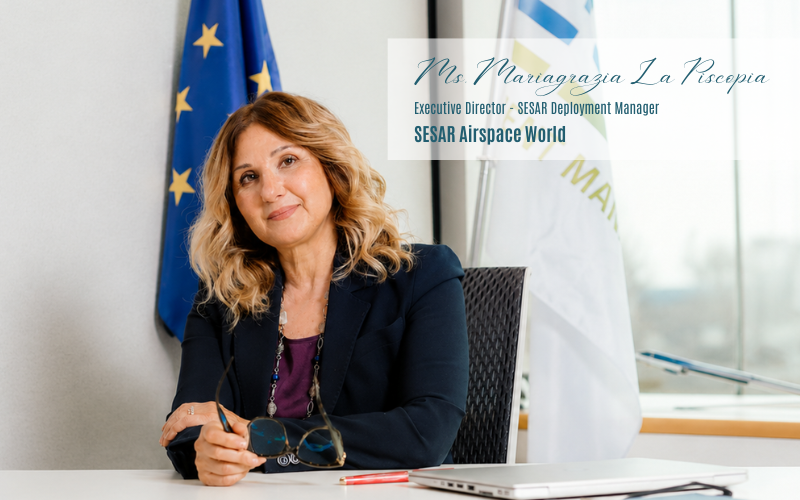
Mariagrazia La Piscopia : The common understanding that research coordination through SESAR was not enough to speed-up the deployment of those technologies which target is to get operational benefits for Europe, Furthermore, that implement new technologies in a synchronized manner across Europe is such a monumental, complex endeavor that stakeholders would require unprecedented levels of coordination. Such coordination could only come from a dedicated function that would help overcoming local perspectives to favor an holistic, EU-wide and network-wide approach.
That’s why the EU adopted the Common Project One, the first Regulation that mandated stakeholders to implement specific technologies, under the coordination of the SESAR Deployment Manager.
AB : SESAR was launched to modernise Europe’s Air Traffic Management ecosystem; what were the biggest operational gaps that motivated this initiative in its early stages?
MLP : The idea behind SESAR was to avoid fragmentation and the lack of coordination that prevented the European ATM from unleashing its full potential: what Europe needed was a true technological shift that would ultimately bring additional capacity to the system and allow the Aviation industry to grow.
20 years after the launch of SESAR we can say that we achieved that goal: the passengers tripled from 2004, and in the last 10 years – notwithstanding Covid and so many other crisis – we had a 20% increase in flights operated in our airspace.
AB : How has the organization evolved from a deployment coordination body into a strategic driver of digital aviation transformation across Europe?
MLP : It was definitively a long journey, but I think the strategic role of the SDM came from the trust and recognition that operational stakeholders granted to us, on the basis of the work we performed. ANSPs, Airlines, Airports, they all saw that the work of SDM was beneficial for them, that it helped their investment to be more effective, and that in the end granted results and benefits for all.
Building this trust helped further engaging them in SDM work, creating a virtuous cycle of participation, collaboration, and commitment to technological deployment.
AB : Could you explain the core technologies and operational solutions currently being deployed under the SESAR programme to improve ATM efficiency and safety?
MLP : The SESAR Deployment Programme regroups 6 ATM functionalities that were deemed the most urgent and important to be deployed across Europe: they span from a better management of airport and TMA operations in the largest hubs in Europe to the adoption of Free Route and Flexible Use of Airspace to make the best use of our common Airspace and increase capacity.
The Programme also includes other key functionalities to help our network operations to be more effectively coordinated, as well as two key technologies that would shape the future decades of ATM: the adoption of SWIM – a new way to process, automate and exchange ATM data – and the initial shift to Trajectory Based Operations.
AB : How is SESAR integrating advanced technologies such as AI, automation, real-time data exchange, and predictive analytics into future air traffic operations?
MLP : We are following a two-fold approach: on one side, we are laying the foundation for any data exchange with SWIM, an industry-wide shift that unlocks the power of automation and digitalisation in our daily ATM operations already today. Starting from the SWIM basis, we are also the path towards the ATM of the future: this will be the level-playing field where new, transformational technologies like Artificial Intelligence, cloud-based and/or virtual services, will come into play.
AB : The organization focuses heavily on synchronized deployment across Europe; what technical challenges arise while ensuring interoperability between multiple aviation stakeholders and national systems?
MLP : It is certainly a tough job. We have hundreds of stakeholders called to invest, each operating with their own systems – often produced by different manufacturers – and subject to local operational constraints, and it is not always easy to find common solutions.
However, we built a common workplan through the SESAR Deployment Programme, so that every organisation knows to which standards, specifications and provisions needs to adhere. This has led to incredible results, particularly when we were able to build multi-stakeholder, synchronised and cross-border projects.
AB : Europe’s aviation market is rapidly evolving with increasing passenger demand and sustainability pressures; how is SESAR adapting its innovation strategy to address these changing requirements?
MLP : We are doing everything that is in our hands. Through our work, we already enabled investments that brought highly-needed additional capacity in the system to allow for a constant growth of traffic, whilst keeping operational performances and unnecessary CO2 emissions in check.
The goal is now to continue on the same path, pursuing a double-ended strategy: on one hand, working to add additional airspace and airport capacity so that the system does not suffer in the next 3-to-5 years.
On the other hand, we are working towards building the system of the next decades: a modular, scalable system that will allow to cope better with the challenges that the future will bring us.
AB : What role does collaborative innovation between airports, airlines, air navigation providers, and regulators play in accelerating ATM modernization projects?
MLP : It is the essential foundation for any progress. There cannot be any ATM modernisation if stakeholders, regulators and institutions do not work together on these matters. The last decade of SDM operations demonstrated that multistakeholder, synchronized deployment regularly outperforms individual initiatives.. It is faster, more cost-effective, and it is the only way to secure operational benefits and an adequate return from the investments.
AB : Are there any ongoing research initiatives focused on integrating drones, urban air mobility, or autonomous aircraft into the future European airspace framework?
MLP : It is one of the priority for the near future. But – in just a few years – it will not be just a matter of research, but actual deployment.
We are working – together with our stakeholders and the SESAR Joint Undertaking – to a new step of ATM Modernisation with Common Project 2: and the integration of new entrants into the Air Traffic Management is clearly marked as a priority for the next 5-to-10 years.
AB : SESAR operates through partnerships involving multiple aviation stakeholders across Europe; how do you maintain strategic alignment among such diverse participants?
MLP : We have two main assets to leverage upon: the first one is the specific setup established by the SDM. We are a Consortium of operational stakeholders, all our staff and expertise come from either ANSPs, Airlines, Airports, Network Manager. This helps us nurturing a specific link with the operational field that always keeps aligned with their needs and ambitions.
The second one is our consultation approach: everything we work upon is constantly consulted with operational stakeholders. Every document, every deployment decision is developed and adopted after extensive, engaging consultation processes, that helps us building buy-in to ATM modernisation and keeping every organisation aligned.
AB : What have been some of the most important lessons learned from managing hundreds of modernization projects simultaneously across different countries and operational environments?
MLP : As SDM, we managed and monitored a portfolio of 359 projects, with more than 340 already closed and put into operations. The main challenge was to coordinate and synchronise so many organisations and stakeholders around agreed timelines and schedules, particularly when external factors like Covid-19 came into the picture.
What we found to be the most effective instrument was the dedicated “hands-on” approach that we kept along the years: we were always ready to support and assist stakeholders in their investments, providing guidance, technical expertise and ad hoc support whenever this was needed.
AB : How does the organization balance innovation, regulatory compliance, operational safety, and cost-efficiency while implementing large-scale ATM transformation programmes?
MLP : The role of SESAR Deployment Manager is exactly to help stakeholders navigating across these different, all critical priorities. Safety and compliance are pre-requisites for every investments in SESAR, but we also found that innovation and cost-efficiency are not necessarily against each other.
In the implementation of the SESAR Deployment Programme, we always developed strategies and solutions that will give a significant operational and economic return on the investment. The ratio between benefits and costs of the SDP is around 6, which means that every € invested will return € 6 of operational benefits.
AB : Air Traffic Management is becoming increasingly digital and interconnected globally; how does SESAR ensure compatibility with international aviation systems and ICAO standards?
MLP : There’s no industry that’s more globally interconnected that Aviation or Air Traffic Management. SESAR has helped the European ATM industry to remain at the forefront of the global competition, so much that today around 70% of the world’s Airspace is controlled through technology that is made in Europe. In light of this specific pioneering role, Europe always played a critical role within ICAO and in the definition of international standards, and all SESAR solutions are developed and implemented with the specific goal of being applicable and operable worldwide.
AB : What emerging international aviation technologies do you believe will have the greatest impact on future ATM modernization and operational efficiency?
MLP : I believe the major transformational impact will come from the switch to the New Service Delivery Model that SESAR stakeholders are working to structure and define today.
When implemented, it will allow ATM to replace legacy, monolithic systems in favor of more flexible, modern and a fundamentally different service-oriented architecture (SOA): this switch will allow for a quicker deployment of new services, functionalities that will allow ATM to address old and new challenges with renewed speed and effectiveness.
AB : How is SESAR collaborating with international aviation research institutions and technology partners to accelerate innovation in smart airspace management systems?
MLP : SESAR is one of the guiding ATM innovation at global level, if the not leading one. ATM is one of the few industries where Europe is actually leading global competition: research and innovation organisations, partners and institutions are looking at us and want to replicate the things we are doing.
What we have to do is keep investing and working together to remain in this leadership position, continuing to attract talents and expertise to continue accelerating the development of the systems of the future.
AB : With air traffic expected to grow significantly by 2035, what major infrastructure and digital transformation priorities will shape the future of the aviation industry?
MLP : We have two main priorities to be pursued in the next decade:
- The first one is to complete the implementation of Initial Trajectory Information Sharing and SWIM, two remaining links of the SESAR Deployment Programme. Combined, they will allow the system to increase its capacity and operational effectiveness, which will be key to accommodate Aviation growth.
- The second one is to increase the resilience of the system and its integration with the military dimension: recent geopolitical events have shown how important is to consider the Airspace as a critical dual use infrastructure to protect, reinforce and enhance
AB : How do you see automation, sustainable aviation, and data-driven decision-making influencing the next generation of global Air Traffic Management systems?
MLP : It’s not just the next generation of ATM systems that will be influenced by automation and other elements: these are all elements that are embedded in the systems that are in operations today: that is the case of sustainability, for instance.
The next generation will be shaped by the same principles, but with new technological solutions at disposal: that is why we will have a new service-oriented architecture where innovative, often automated features and services will be available for stakeholders, facilitating unprecedented levels of performance.
AB : What opportunities and challenges do you foresee for international collaboration in building a safer, greener, and more resilient aviation ecosystem over the next decade?
MLP : International collaboration is the only way to achieve significant, tangible results. There is no effective implementation in ATM if it is not run at international level, particularly in such a complex and interdependent system like the European one.
AB : Sustainability has become a critical topic in aviation; how is SESAR contributing toward reducing emissions, fuel consumption, and environmental impact through ATM modernization?
MLP : ATM modernisation is the fastest and most cost-effective way to achieve environmental improvements in Aviation: through our portfolio of coordinated SESAR deployment projects alone, we deployed technologies poised to save over 21 million tons of unnecessary CO2 emissions.
That is thanks to solutions and technologies that help saving fuel and flight time to airlines, and all at a remarkable value-for-money: every € invested in the implementation of the Common Project 1 saves more than 4 kilos of CO2 emissions.
AB : How does the organization ensure that technological advancements in aviation continue to prioritize passenger safety, operational transparency, and public trust?
MLP : This comes from our specific setup and positioning at the crossroads between EU institutions and ATM stakeholders: on one hand, our consultation process makes sure operational stakeholders are duly involved and on the other side, our specific arrangements with the European Commissions secure the EU policy objectives and the overall passenger and public interest are constantly pursued.
AB : What initiatives are being implemented to support greener aviation policies aligned with the European Green Deal and broader environmental objectives?
MLP : From our SDM perspective, we helped deploying some of the most critical ATM solutions with a positive environmental impact: Free Route Airspace – which allows airlines to fly more direct and shorter flights – Extended AMAN, Network Collaborative Management.. all of these solutions – widely available now in our skies – allow Airspace Users to limit their jet fuel consumption, and consequently their emissions. All in all, it has a remarkable effect to limit carbon emissions and align with the policy objectives of the EU.
About the Author