

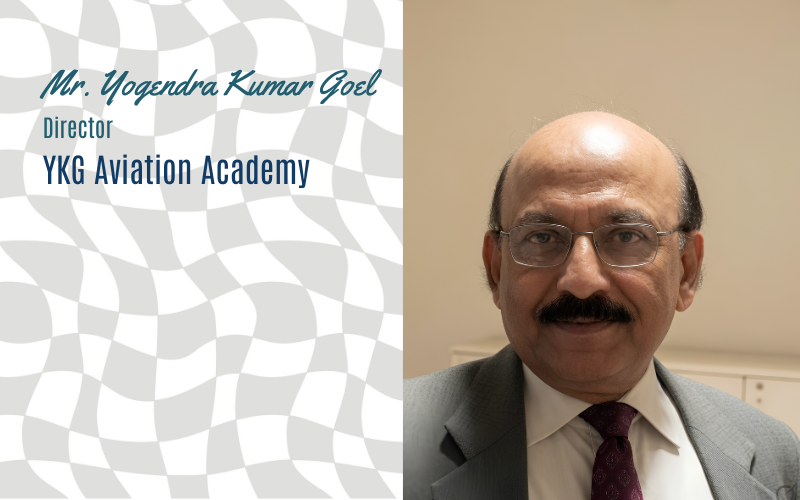
YKG Aviation Academy has foreign collaboration in the middle east countries and imparting training on Dangerous Goods Regulations and other IATA Approved Courses in Aviation beyond the boundaries of India. Our faculties for Dangerous Goods Regulation Training Program have not only been approved by DGCA, India, but also approved by Bahrain Civil Aviation Authority, Bahrain and General Authority in Civil Aviation (GACA), Saudi Arabia.
AviationBizz : How did the idea of establishing YKG Aviation Academy originate, and how has the academy continued to align its vision with industry advancements?
YKG : Being passion for training, I got association with Indian Aviation Academy, Airports Authority of India in 1995, when I got opportunity to join an ICAO Project of TRAINAIR under which AAI developed Global training Package on “Bird Hazard Control Management. Since then, I continued with Cargo Trainings in IAA, earstwhile NIAMAR, Training Institute of Airports Authority of India. After superannuation from AAI, I joined GMR Aviation Academy to conduct cargo trainings including Dangerous Goods Training program. Due to COVID, the training programs could not be continued.
There was lack of trained manpower in Aviation. Having long experience in aviation, I decided to give back to aviation industry and after COVID, I decided to establish my own Academy and established YKG Aviation Academy and got approval for 14 IATA courses. Being specialization in Dangerous Goods Training Program, I continued DGR Training after approval from DGCA and IATA..
AB : Looking back at your journey, what were the key challenges faced during the academy’s initial years, and how were they overcome?
YKG : After establishing the Academy, YKG Aviation Academy got the DGCA approval after 20 months, It was challenge for me to run academy without much trainings and resulted into financial loss but somehow, I managed. Once I got approval from DGCA and IATA in 2021, I got lot of requirements for DGR Training due to quality of the Training. Fortunately, I got approval from Bahrain Civil Aviation Academy, Bahrain and GCAA of UAE for DGR Training, I started doing training across Indian borders. YKG Aviation Academy is the only Academy which is conducting DGR training in Three countries, i.e. India, Bahrain and UAE.
AB : As aviation continues to transform globally, what motivates your institution to continuously innovate and expand its educational offerings?
YKG : There were many senior experienced AAI Officers who superannuated from Airports Authority of India. I decided to establish the Academy to give platform to these officers to share their knowledge and experience and to provide skilled manpower to the industry.
AB : Could you provide an overview of YKG Aviation Academy’s mission, core values, and its role in developing skilled aviation professionals?
YKG : YKG Aviation Academy has been established as an innovative aviation training provider to bridge the gap between the employer’s expectation and employee’s performance, which results to achieve the organizational goals as well as their individual goals.
AB : What distinguishes YKG Aviation Academy from other aviation training institutes in terms of curriculum quality, industry relevance, and student outcomes?
YKG : The Core strength of YKGAA is its highly experienced faculty with 30 to 40 years of experience in the Aviation industry. After completion of any of these Courses, the opportunity is provided to have placement with Airlines, Airports, Cargo and Hospitality industry to get placement.
AB : How has the academy strengthened its position as a trusted training partner for aspiring professionals in aviation, travel, and logistics sectors?
YKG : Considering the expertise of the highly experienced faculty, the trainings of YKG AA are appreciated by the participants. This factor attracted the Academies from other countries to get associated with YKG Aviation Academy to train their aviation personnel in those countries. We stressed on the professional approach to the trainings and experienced faculties shared the case studies experienced by them to give real examples.
AB : YKG Aviation Academy offers a diverse range of aviation and travel-related programs. How are these courses designed to align with current industry requirements?
YKG : Since YKG AA conducts IATA courses, all these courses have standardized contents which are recognized globally. The course contents are designed based on the aviation industry requirements. The training is supplemented by practical case studies on real situations by highly experienced faculties.
AB : What measures are taken to regularly update course content so that students remain prepared for emerging aviation technologies and operational practices?
YKG : Since IATA keeps on updating the course contents on the basis of the new technologies and development in aviation industry. Instructors also update themselves by participating in various international seminars and workshops etcby international bodies.
AB : Are there any new certification programs, specialized training modules, or research-based learning initiatives currently under development?
YKG : We designed the trainings considering the industry requirements. Now ICAO has converted all the training programs with a new approach of Competency Based Training and Assessment (CBTA). Under this approach, the trainee has to be competent in their work by having their regular assessment at their work place.
AB : How do your training facilities, simulation resources, and learning environments contribute to providing students with practical industry exposure?
YKG : CBTA Dangerous Goods Training program is a mandatory training requirement for aviation personnel. Dangerous Goods laboratory is established to give practical experience to the trainees. This helps them to have practical experience during training and able to retain the learnings.
AB : What investments have been made in recent years to enhance the academy’s infrastructure and improve the overall learning experience?
YKG : Considering the expansion of aviation industry, addition of new airports in India and forthcoming addition of number of aircrafts by 2030, there will be tremendous requirement of skilled personnel in aviation.
AB : How important is technology-enabled learning within your campus ecosystem, and what future upgrades are being planned?
YKG : Since our training programs are for ground personnel to work in Cargo and Passenger handling, we provide both online and offline trainings. Thus we are able to reach candidates outside Delhi, in other states also. YKG AA is planning to have workshops in the schools for the 10+2 students who are passing out of the school. This helps them to know about Aviation and to take decision how they can grow with aviation industry. YKG AA is planning to associate with some of the Universities providing aviation courses so as to have some value addition to the degree provided by the universities by having globally recognized IATA certificates..
AB : How does YKG Aviation Academy collaborate with airlines, airports, logistics companies, and travel organizations to provide real-world industry exposure?
YKG : We coordinate with the industry partners to give exposure to our trainees to have practical industry experience. This helps the trainees to get job if their performance is appreciated by the industry partner.
AB : What role do internships, industrial visits, and guest lectures play in preparing students for successful careers in aviation and allied sectors?
YKG : Exposure to the real situations helps the trainees to have more confidence and better learning and are able to start their career.in the industry.
AB : In your view, what are the most valuable industry skills students gain through these exposure programs beyond classroom learning?
YKG : Though the trainees learn during training by practical demos and case studies, but exposure to industry gives them more confidence and better understanding of the subject to get job..
AB : Apart from technical education, how does the academy focus on developing communication, leadership, and professional skills among students?
YKG : We assess the trainees during the training. If we find that they are lacking communication skills, we prepare them for improving communication and how to do better in interview by providing additional classes.
AB : What support systems are available to help students enhance employability and successfully transition into the workforce?
YKG : We assess our trainees and if find suitabile we provide interview opportunity to them by coordinating with industry partners.
AB : Could you share examples of alumni achievements that reflect the effectiveness of the academy’s student development initiatives?
YKG : Many of our trainees trained by YKG AA are working as faculties and involve with the training programs at various institutes or academies. They are further providing training to have more skilled manpower.
AB : How are emerging technologies such as Artificial Intelligence, digital aviation systems, and data analytics influencing your training methodologies?
YKG : In Dangerous Goods training programs, instructor may receive AI generated case studies tailored to recent regulatory changes and common student errors. It will reduce the training time and improve retention.
AB : How do you foresee technology transforming aviation education over the next decade, and what strategic preparations are already underway?
YKG : Aviation education is likely to undergo a major transformation driven by Artificial Intelligence, data analytics, digital learning platforms, and competency based training in the next decade.
About the Author