Pos Aviation
Pos Aviation is a key player in Malaysia’s aviation sector, serving as the country’s leading independent ground handling provider. Originally established in 1995 as KL Airport Services (KLAS), it is now a core subsidiary of Pos Malaysia Berhad under the broader DRB-HICOM umbrella. The company provides a “one-stop-shop” for airlines, covering everything from passenger handling and inflight catering to cargo logistics and aircraft maintenance. Operating out of major hubs like KLIA and several regional airports, it acts as the backbone for numerous international carriers, ensuring that ground operations—from the check-in counter to the cargo hold—run smoothly and safely.
Aviation Bizz : What inspired the founding of Pos Aviation in 1995 and the focus on becoming Malaysia’s independent aviation ground services provider?
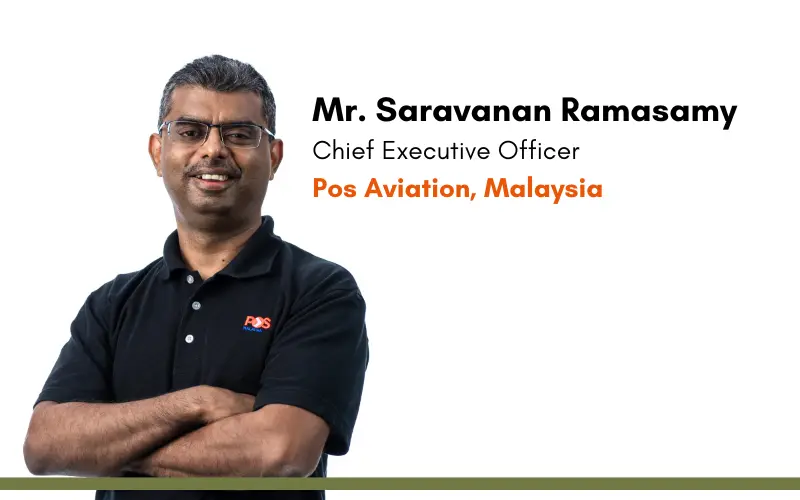
Saravanan Ramasamy : Pos Aviation was established in 1995 as KLAS (KL Airport Services) with a clear ambition — to become Malaysia’s independent aviation ground services provider, delivering reliable, neutral and high-quality operational support to airlines operating into the country. The company was founded to bridge the operational gap between international carriers, airport authorities, and regulators. From the outset, Pos Aviation positioned itself as a neutral ground handling partner — serving all airlines equally with no affiliation to any single carrier.
Today, we operate across 11 airports nationwide, including major gateways such as Kuala Lumpur International Airport (KLIA), Penang, Kota Kinabalu, Kuching, Tawau, Subang and Melaka.
AB : How did your early experiences in the aviation sector influence the company’s vision and commitment to operational excellence across multiple service areas?
SR : My early career experience with airlines provided valuable insight into the operational expectations and challenges faced by carriers on the ground. Working closely with airline operations highlighted the critical importance of reliability, safety, and disciplined turnaround management in maintaining schedule integrity and delivering a seamless passenger experience.
These experiences shaped Pos Aviation’s approach to service delivery — placing strong emphasis on operational precision, strict adherence to safety standards, and close coordination with airline partners and airport stakeholders. They also reinforced the importance of building capabilities across multiple service areas, enabling Pos Aviation to provide integrated support in ground handling, cargo operations, engineering services, and inflight catering while maintaining consistent quality and efficiency across its network.
AB : Which guiding values established during Pos Aviation’s early years continue to shape the company’s culture and strategic priorities today?
SR : Pos Aviation’s culture and strategic direction are anchored on three core pillars:
Pillar 1: Highly Motivated, Engaged, and Safe Employees
Safety is the top priority across all operations, with a strong commitment to building a proactive safety culture. We focus on keeping employees motivated, engaged, and valued, recognising that people are its greatest asset. Regular appreciation and recognition programmes reinforce a performance-driven and accountable workforce.
Pillar 2: Delivering Great Service and Delighting Customers
Disciplined operations and consistent quality execution underpin service delivery. Pos Aviation is committed to exceeding customer expectations across its nationwide network by maintaining high standards in safety, reliability, and responsiveness.
Pillar 3: Delivering a Profitable Network
Sustainable growth is guided by prudent cost management, continuous productivity improvements, and disciplined expansion. We remain focused on strengthening operational efficiency while ensuring long-term commercial viability.
AB : Can you describe the full range of services and technologies Pos Aviation offers, including ground handling, cargo and e-commerce logistics, inflight catering, and aircraft maintenance & engineering?
SR : Pos Aviation operates as an integrated aviation services provider across four core pillars:
Ground Handling – Passenger check-in, ramp handling, baggage services, aircraft turnaround
Cargo Handling & CSA (Cargo Sales Agent) – Warehousing at five airports (KLIA, Penang, Kota Kinabalu, Kuching, Tawau) Engineering & Line Maintenance – Aircraft certification between flights via joint venture with Singapore Airlines Engineering Company (SAEC), with Pos Aviation holding 51% stake
Inflight Catering – Scalable kitchen operations producing up to 20,000 meals per day; Malaysia Airlines accounts for approximately 60% of meal production.
AB : What tecWhat technologies or systems (e.g., cargo management platforms, digital flight support tools) are central to ensuring efficiency across your core service lines? hnologies or systems (e.g., cargo management platforms, digital flight support tools) are central to ensuring efficiency across your core service lines?
SR : Pos Aviation leverages several digital systems to enhance operational efficiency and service reliability across its core business lines. These include digital resource management and training management systems that optimise manpower deployment based on skills, certification, and operational demand.
In cargo operations, the Cargo Management System plays a central role in managing shipment processing, documentation accuracy, and cargo traceability across warehouse facilities. Additionally, the Commercial Billing System supports efficient revenue management by streamlining billing processes, improving financial accuracy, and ensuring timely invoicing for airline partners.
Together with telematics monitoring for ground support equipment and other digital workflow initiatives, these systems enhance operational visibility, compliance tracking, and productivity across Pos Aviation’s nationwide network.
AB : How does Pos Aviation maintain quality and safety standards across its operations at multiple airports nationwide?
RG : Safety is paramount. Pos Aviation complies with Civil Aviation Authority of Malaysia (CAAM) regulations, adheres to IATA standards, and was among the first ground handlers in Malaysia to achieve ISAGO certification.
Operational KPIs include on-time performance, baggage delivery times, and mishandling rates — consistently maintained below 1%, outperforming industry benchmarks.
AB : Is Pos Aviation exploring new digital systems such as AI-enabled process optimisation or real-time operational analytics to enhance ground handling, baggage flow, or cargo services?
RG : Yes. Digitalisation and automation remain key priorities for Pos Aviation as it continues to improve operational efficiency and service reliability. We have implemented digital resource management and training management systems to optimise manpower deployment and ensure compliance with operational and regulatory requirements. We are also strengthening our Cargo Management System to enhance cargo documentation accuracy, operational visibility, and processing efficiency. In addition, the Commercial Billing System has been implemented to streamline billing workflows, improve revenue tracking, and enhance financial transparency for airline customers.
Alongside these initiatives, Pos Aviation continues to explore data-driven tools and operational analytics to improve turnaround coordination, baggage flow monitoring, and equipment utilisation, ensuring that digital investments translate into measurable productivity and service improvements.
AB : Which market segments (e.g., international airlines, cargo operators, air taxi services, and charter flights) provide the largest demand for Pos Aviation’s services, and how do service needs differ among them?
RG : Pos Aviation’s largest demand comes from international airlines operating into Malaysia, where we command approximately 60% market share among foreign carriers (excluding self-handled airlines). These carriers rely heavily on consistent passenger handling, ramp operations, baggage management, and aircraft turnaround services delivered to strict scheduling and safety standards.
Cargo operators represent another significant segment, driven by stable air freight volumes and growing e-commerce activity. Their service requirements are distinct — prioritising warehouse efficiency, documentation accuracy, security compliance, and time-sensitive cargo coordination.
Charter operators, VIP movements, and special flights require a different operational model altogether — emphasising discretion, flexibility, rapid coordination, and high-touch service delivery. These operations often involve complex regulatory clearances and bespoke ground arrangements.
By understanding the differing operational priorities of each segment — schedule integrity for passenger airlines, throughput efficiency for cargo operators, and precision coordination for charter and VIP flights — Pos Aviation is able to tailor its service model while maintaining consistent safety and quality standards across its nationwide network.
AB : How has customer demand evolved in recent years for example toward paperless cargo processing or sustainability-driven operations and how has the company responded?
RG : Customer demand has shifted toward faster turnaround times, greater operational transparency, and stronger sustainability performance. Airlines now expect digital workflows, improved data accuracy, and measurable ESG outcomes.
In response, Pos Aviation has accelerated digitalisation across cargo and ground operations to streamline documentation, enhance traceability, and improve efficiency.
At the same time, we have invested in sustainability initiatives such as a 1.9MW solar photovoltaic system, electric ground equipment trials, and reduced paper-based processes — aligning operational improvements with both customer expectations and long-term cost discipline.
AB : How does Pos Aviation collect and use customer feedback to inform product and service innovation across its service portfolio?
RG : Pos Aviation gathers structured feedback through monthly performance review meetings with airline partners, where operational KPIs, service gaps, safety observations, and improvement opportunities are discussed in detail.
In addition, a biannual Net Promoter Score (NPS) survey is conducted to capture broader customer sentiment and benchmark service performance across stations.
Insights from these engagements are translated into targeted action plans — including process refinements, manpower adjustments, additional training, and system enhancements — ensuring that service innovation remains data-driven, measurable, and aligned with evolving airline expectations.
AB : What strategic priorities guide Pos Aviation’s growth such as strengthening partnerships with airlines, expanding airport coverage, or diversifying into e-commerce logistics?
RG : We prioritise strengthening airline partnerships, optimising its multi-airport network, defending its core ground handling franchise, expanding engineering services, and enhancing cargo capabilities while maintaining cost discipline.
AB : How has Pos Aviation’s experience across nine Malaysian airports shaped its approach to scalable operational excellence and service consistency?
RG : Operating across 11 airports has reinforced standardised SOPs, strong governance, and disciplined coordination. Scalability is achieved without compromising safety or service consistency.
AB : What operational challenges (like workforce training, regulatory compliance, or cross-airport coordination) have shaped your business strategy, and how have you addressed them?
RG : Key challenges include labour cost inflation, competitive pricing pressures, capital-intensive GSE investments, and legacy infrastructure constraints. Mitigation strategies include selective outsourcing, digitalisation, equipment, and strong stakeholder collaboration.
AB : How does Pos Aviation ensure robust after-sales support, such as technical follow-ups for cargo systems or quality assurance for inflight services?
RG : Ongoing airline engagement, performance reviews, audit follow-ups, and technical coordination ensure continuous service improvement and sustained operational support.
AB : From Pos Aviation’s perspective, how have aviation ground services technologies such as digital cargo systems or automated ramp tools evolved across Asia over the past decade?
RG : The industry has moved toward digital cargo systems, predictive maintenance, connected ramp operations, and data-driven fleet management. Automation and analytics are becoming central to efficiency and safety.
AB : Is the company exploring emerging technologies like IoT-enabled equipment monitoring, automated baggage sorting, or predictive maintenance analytics to enhance service quality and uptime?
RG : Yes. Telematics and data analytics are being piloted to monitor GSE utilisation and enhance preventive maintenance planning, improving uptime and safety oversight.
AB : How does Pos Aviation benchmark its technology adoption against aviation service best practices in fast-developing markets like India and Southeast Asia?
RG : Pos Aviation benchmarks its technology adoption through a combination of strategic partnerships, industry engagement, regulatory alignment, and collaboration with established aviation service providers across Southeast Asia. These collaborations allow us to exchange operational insights, evaluate emerging technologies, and align with evolving industry standards.
In addition, Pos Aviation actively participates in international aviation and ground handling conferences worldwide, which provide valuable platforms to track technological advancements, operational innovations, and best practices adopted by leading ground service providers. These engagements enable us to continuously assess our capabilities, identify relevant digital solutions, and adopt technologies that enhance operational efficiency, safety, and service reliability.
AB : What growth opportunities do you foresee for aviation ground support, cargo handling, and inflight catering services in the next 5–10 years especially with e-commerce and air logistics expansion?
RG : Rising passenger traffic, e-commerce-driven cargo demand, and digital transformation present strong opportunities for integrated aviation service providers capable of scaling efficiently.
AB : How is Pos Aviation planning to expand its service portfolio, geographic reach, or technology capabilities to capitalize on these future trends?
RG : Pos Aviation is pursuing a balanced growth strategy focused on strengthening its core capabilities while capturing new opportunities within the aviation services sector. We continue to advance digital initiatives to enhance operational efficiency, improve resource planning, and support data-driven decision-making across its operations.
From a commercial perspective, we are actively strengthening our marketing and engagement efforts to attract new airline customers while maintaining strong relationships with existing partners. By delivering consistent service quality, operational reliability, and scalable solutions across multiple airports, Pos Aviation aims to support airline network growth while reinforcing long-term customer partnerships.
AB : What external challenges such as regulatory shifts, competitive pressures, or rising labour costs might impact the industry’s growth, and how is the company preparing to address them?
RG : Challenges include labour cost increases, regulatory shifts, competitive pressures, and infrastructure constraints. Mitigation includes cost discipline, productivity improvements, digitalisation, and stakeholder collaboration.
AB : In what ways do global shifts like green logistics and digital transformation influence Pos Aviation’s future strategies?
RG : Sustainability investments — including solar energy and electric equipment trials — alongside digital workflow optimisation ensure alignment with global aviation decarbonisation and efficiency trends.
About the Author